
Our services
Recovery Compression
Reviewed by Andrew Macdonald, Senior Physiotherapist , AHPRA registered (PHY0002098797), APA member
What is recovery compression?
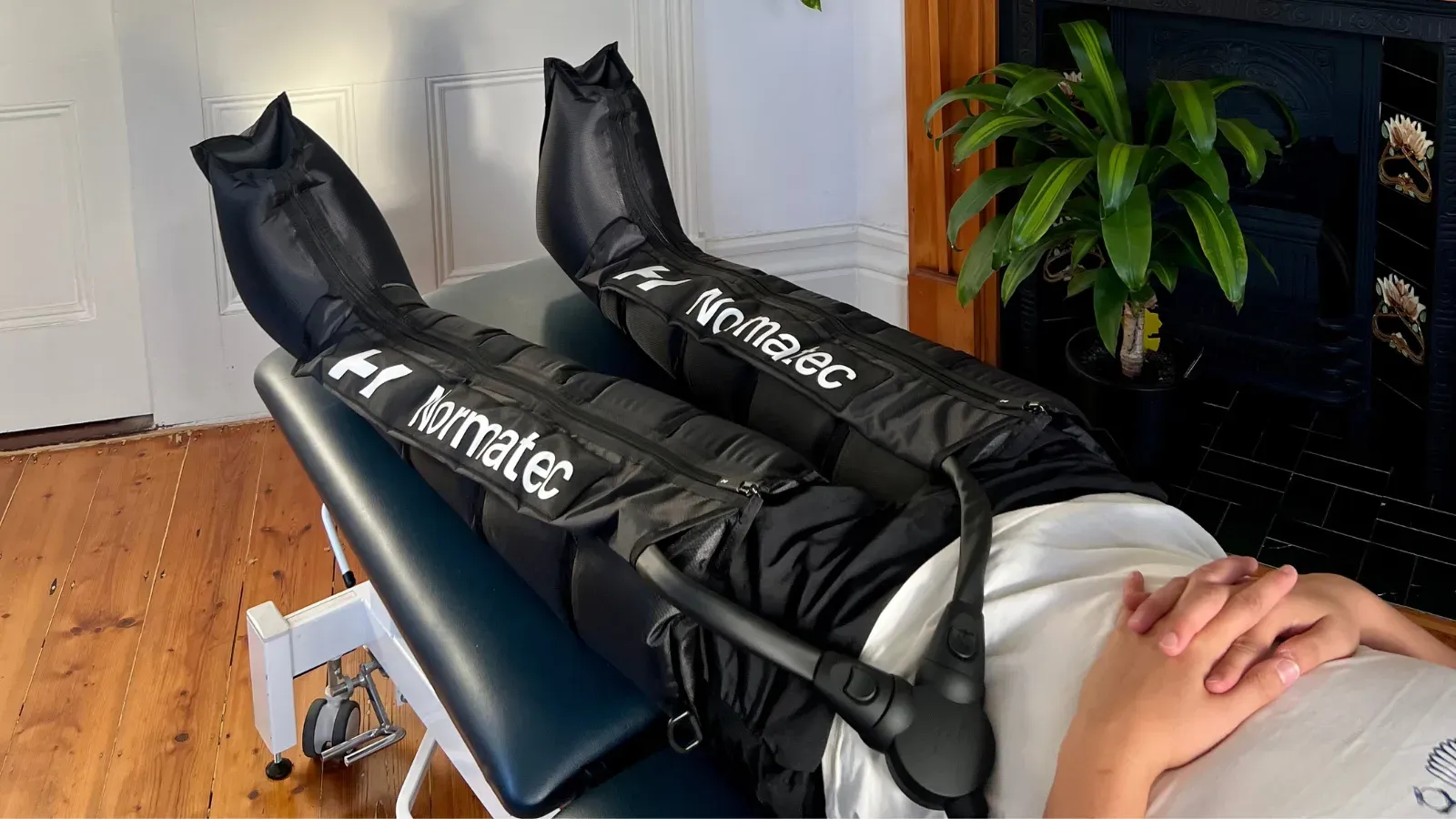
Recovery compression uses inflatable boots that wrap the legs from foot to thigh and fill with air in a repeating sequence. The clinic uses Normatec boots, the same type widely used in sports recovery settings. Andrew uses them within a physiotherapy appointment, most often for people training heavily, returning to running, or arriving with legs that feel heavy and tired rather than injured.
It sits alongside the hands-on parts of a session rather than replacing them. The boots do something your hands cannot: apply an even, rhythmic squeeze to the whole limb while Andrew works on something else or talks you through your programme.
How it works
Each boot is divided into chambers running from the ankle to the top of the thigh. The chambers inflate one after another, starting at the foot, so the pressure travels upward in a wave and then releases before the cycle begins again. This is called intermittent pneumatic compression, and it is the same principle used in hospitals to keep circulation moving in people who cannot walk.
Squeezing the limb from the bottom up assists venous return — the movement of blood and fluid back toward the trunk against gravity. Between cycles the pressure drops away completely, which lets the vessels refill before the next wave. Most of the published research uses sessions of twenty to thirty minutes at a moderate pressure; Andrew sets both to suit you and what the rest of the appointment involves.
What it helps with
Andrew uses the boots as a recovery adjunct rather than a treatment for a specific diagnosis. They suit the session that follows a hard training block, a long run or a race, and the person whose legs feel heavy, tight and tired several days into a heavier week. They also give a useful stretch of passive time inside a longer appointment, which works well at the end of a session that has already involved manual therapy or dry needling.
Because the boots address how the whole limb feels rather than one restricted structure, they are used alongside the rest of your treatment — manual therapy for specific tissue, dry needling for overactive muscle, and the exercise programme addressing whatever is driving the load in the first place.
What the evidence supports
Pooled analysis of the trials finds the clearest effect on perceived soreness — how sore your legs feel in the days after hard exercise. Effects on measured muscle function are small, and effects on blood markers of muscle damage vary so much between studies that no reliable conclusion sits underneath them.
So the boots are used here for what the research shows: legs that feel less sore and less heavy afterwards. That is worth having after a hard week, and it is the claim the evidence carries. Anything beyond it — training harder, healing faster, avoiding injury — belongs to your programme rather than to a pair of boots.
What to expect during a session
Andrew will ask about your training, how your legs feel and anything relevant in your medical history before using the boots. You stay fully clothed, lying on the treatment table, and the boots go on over your leggings or shorts.
The first cycle starts gently so you can feel the pressure before it builds. From there each cycle takes about a minute to travel from foot to thigh. Most people read, talk or simply rest through it. The pressure is adjustable throughout and comes off immediately if you want it to — the release is a single button.
Afterwards the legs usually feel lighter and a little warmer. There are no marks and nothing to manage at home, so you can train, drive or go back to work straight away.
Is recovery compression right for you?
The boots are well tolerated by most people, and Andrew screens for a short list of things before using them.
Tell him at your appointment if you have a known or suspected blood clot in the leg, circulation problems or diagnosed arterial disease, heart failure or leg swelling that has not been explained, an open wound, active infection or rash on the leg, a recent fracture or recent surgery on the limb, or reduced sensation that would stop you feeling the pressure properly. Any of these is a reason to check rather than an automatic no, and where the boots are not appropriate, manual therapy and a graded return-to-load programme do the more important work anyway.
If you are pregnant, mention it and Andrew will talk through whether it suits you on the day.
Frequently asked questions
What do the boots do?
The boots inflate in sequence from the foot upward, squeezing each section of the leg in turn before releasing. That pattern assists venous return, moving blood and fluid back toward the trunk more quickly than resting alone does. The effect people notice is on how sore the legs feel afterwards.
Does it clear lactic acid?
No, and that claim is worth setting aside. Lactic acid clears from muscle within roughly an hour of finishing exercise, well before most people reach a recovery session, and the soreness that arrives a day later has a different cause. What the boots assist with is circulation and the feeling of heaviness that follows heavy training.
How long is a session in the boots?
The research generally uses twenty to thirty minutes at a moderate pressure. Andrew sets the time and pressure to suit you and the session, and you can ask him to stop at any point.
Can I book the boots on their own?
No. Recovery compression is used within a physiotherapy appointment alongside hands-on treatment and your exercise programme, in the same way cupping and dry needling are. It is not sold as equipment and there is no separate charge for it.
What does it feel like?
A firm, moving squeeze that travels up the leg and then releases, repeating in cycles. Most people find it comfortable and a few find it pleasant. It should never be painful, and the pressure comes down straight away if it is.
Ready to book your appointment?
Got a question first? Ask Andrew, it's free →